
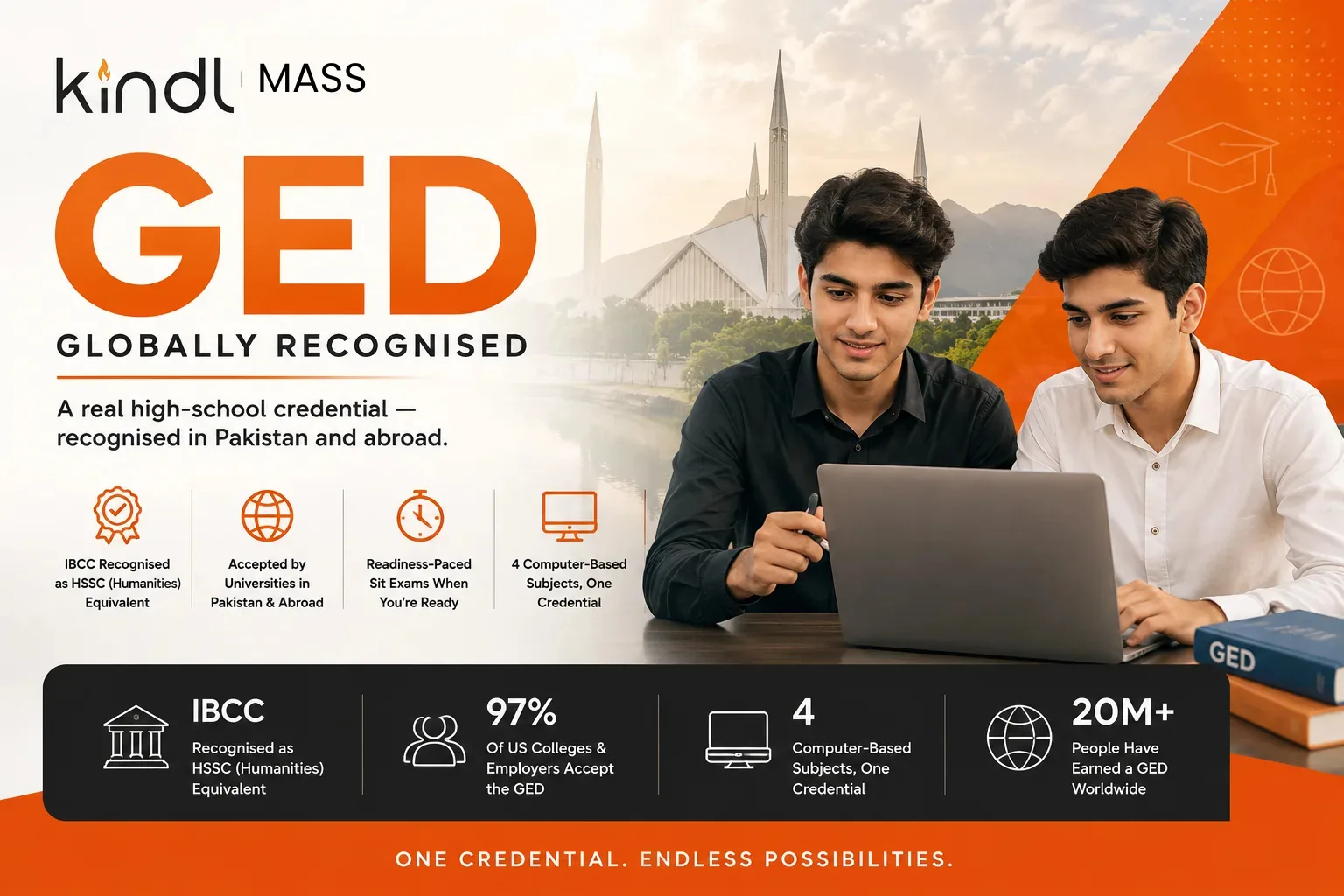
GED · Globally Recognised
A real high-school credential — recognised in Pakistan and abroad.
The GED is a globally recognised high-school-equivalent qualification — four computer-based subjects, recognised by the IBCC as equal to HSSC (Humanities). Finish when you're genuinely ready, not on a fixed two-year calendar.
- IBCC-recognised as HSSC (Humanities) equivalent
- Accepted by universities in Pakistan & abroad
- Readiness-paced — sit exams when you're ready
Talk to a GED advisor
Tell us a little about your situation. We'll explain your GED path — recognition, timeline, and next steps — and reply within 48 hours.
Recognised as HSSC (Humanities) equivalent
Of US colleges & employers accept the GED
Computer-based subjects, one credential
People have earned a GED worldwide
A rigorous credential — without the rigid calendar.
The GED isn't easier than the traditional route. It's structured differently, and the IBCC treats it with the same seriousness. The difference is who sets the pace.
Traditional Intermediate
Every student moves at the same speed — two years, no exceptions, regardless of how ready any individual student actually is.
GED at KINDL
Readiness sets the timeline. A rigorous qualification shouldn't be stretched across two fixed years just because that's how the system has always run.
Is the GED right for you?
Students who lost time
A gap year, a school that didn't fit, an interrupted college — the GED is a clean, recognised way back onto a university track.
Homeschooled & alternative learners
Learning outside the mainstream system? The GED converts that learning into a credential the IBCC and universities recognise.
University-abroad hopefuls
Accepted by universities across the US, UK, Canada, and the Gulf — often without the two-year local waiting period.
Fast, focused finishers
Ready before the calendar says so? Sit the exams when you've genuinely mastered the material — not two fixed years later.
Is the GED your route?
Answer three quick questions and we'll point you to your best next step. Nothing is stored — it's just to guide the conversation.
Question 1 of 3
Have you completed Matric or O-Levels?
From Matric to university, step by step.
No shortcuts hidden in the small print. Here's the whole path, exactly as it runs.
Finish Matric or O-Levels
The GED builds on top of secondary school. Matric or O-Levels comes first, exactly as it would on any other path.
Prepare with KINDL
Structured, subject-by-subject prep. KINDL is actively securing Authorized GED Prep Provider status — the approval required in Pakistan before booking the official test.
Sit four computer-based subjects
Reasoning Through Language Arts, Mathematical Reasoning, Science, and Social Studies — taken at an official testing centre when you're ready, one at a time.
Get your IBCC equivalence
The IBCC issues an HSSC (Humanities Group) equivalence certificate. Note: a two-year gap after Matric applies for local equivalence — it does not apply if you're heading abroad.
Apply to university
Use the equivalence to apply to Pakistani universities in Humanities, Social Sciences, Business, Media, Design & Law — or apply directly abroad.
Four subjects, one credential.
Reasoning Through Language Arts
Reading comprehension, grammar & writing.
Mathematical Reasoning
Algebra, geometry & data — with an on-screen calculator.
Science
Life, physical & earth science reasoning.
Social Studies
Civics, history, economics & geography.
Each subject is taken separately at an official computer-based testing centre — you don't sit all four in one day.
Where a GED can take you.
The question every parent asks is whether this will actually be recognised. It deserves a real answer, so here it is, in full.
In Pakistan
The IBCC recognises the GED as equivalent to HSSC (Intermediate) in the Humanities Group — opening university admission in Humanities, Social Sciences, Business, Media, Design & Law, subject to each institution's own entry requirements. It does not cover Medical (MDCAT) or core Engineering (ECAT) locally.
Beyond Pakistan
The GED is accepted by 97% of US colleges and employers, and considered for undergraduate admission by universities across the UK, Canada, and the Gulf. Heading abroad, the two-year local waiting period doesn't apply — you can apply directly.
Official testing
Exams are booked through the official GED testing system, and KINDL's prep is a separate track. We'll walk you through exactly what's involved on your counselling call.
Your pace
Sit each subject when you're ready. Many finish well inside two years — the timeline follows readiness, not a fixed calendar.
18+
Standard age is 18. Ages 16–17 can qualify through an official age-waiver process. Matric or O-Levels is required first.
GED vs traditional (FSc / Intermediate).
GED, answered honestly.
Yes. The Inter Board Committee of Chairmen (IBCC) recognises the GED as equivalent to HSSC (Intermediate) in the Humanities Group, once the required conditions are met. That equivalence is what universities look for.
Source: official GED.com Pakistan policy page and IBCC equivalence guidance. Requirements can change — confirm current details with us before you commit. For the full detail, read our complete GED in Pakistan guide, IBCC equivalence & the two-year gap, GED video lectures & online prep, and verified GED fees.
Not sure if the GED is your route? Let's find out together.
Book a free counselling call. We'll map your situation to a clear plan — recognition, timeline, and the right next steps for you.